

As business energy consultants, we are constantly on the lookout for the finest deals on the market for our clients, and we work tirelessly to achieve these. Our monthly market reports provide views directly from our specialists. Use our price analysis, market signals, and political changes to help you make the right choice when it comes to energy decisions.
Download PDFDisclaimer: The information contained in this document has been prepared in good faith by Ginger Energy and provides our views on current/future trends and outcomes, but, as with all forecasts dependent upon multiple, complex variables, there is no certainty whatsoever that our forecasts will turn out to be correct. The information may be based on licenced 3rd party data, publicly available sources, assumptions, and observable market conditions and may change without notice. No warranty, express or implied, is made as to the accuracy, correctness, fitness for purpose, completeness or adequacy of this information nor is it intended to serve as basis for any procurement decision and as such Ginger Energy shall not accept any responsibility or liability for any action taken, financial or otherwise, as a result of this information. Please note that this email is intended for the recipient only and may not be copied, reproduced, or distributed without the prior consent of Ginger Energy.
Market Context
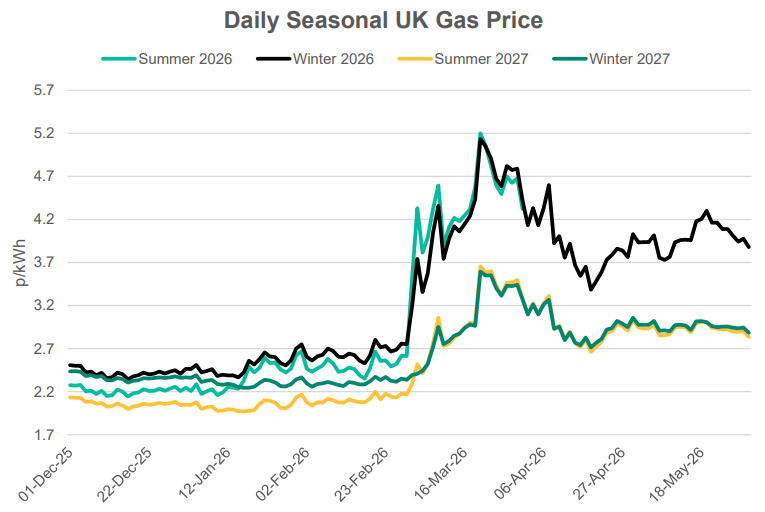
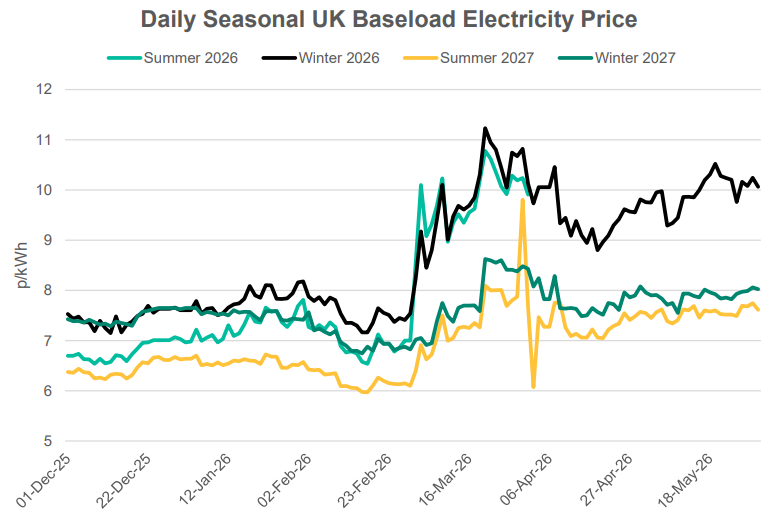
UK gas and power curves strengthened across May, with risk premium concentrated in winter and annual products as geopolitical uncertainty, LNG disruption and weak European storage outweighed softer summer demand signals. Prices were volatile rather than one-directional: ceasefire headlines around the Strait of Hormuz, the key Gulf shipping route for oil and LNG, periodically pushed the curve lower, but the market remained cautious because physical shipping did not return to normal and Europe’s storage position stayed below seasonal norms.
- Early in the month, forward prices were supported by renewed US-Iran tensions and disruption around the Strait of Hormuz, with oil and LNG risk premium feeding directly into UK gas and power contracts.
- By Mid-month, the curve remained underpinned by uncertainty over whether limited vessel movements through the Strait of Hormuz represented a genuine reopening or only controlled passage.
- Towards the end of May, peace-deal optimism pushed prices lower at times, but fresh US-Iran strikes, sanctions and continued restrictions on shipping kept winter risk premium in place.
- LNG availability remained a key concern, with disruption to Middle Eastern exports and stronger Asian cooling demand increasing the risk of Europe facing greater competition for flexible cargoes.
- Prompt prices were volatile, with lower wind output, cooler spells and Norwegian supply issues lifting gas-for-power demand and supporting nearterm prices at points during the month.
- European gas storage stood at around 39% full, below the five-year average of around 51%, leaving winter contracts sensitive to the pace of summer injections.
- Warmer weather and lower heating demand should reduce near-term gas consumption
- Improved Norwegian flows would ease the UK prompt balance and support European storage injections
- A credible US-Iran agreement reopening the Strait of Hormuz would reduce LNG and oil risk premium.
- Continued disruption through the Strait of Hormuz would keep LNG supply and shipping risk elevated.
- European gas storage remains below normal, leaving winter contracts sensitive to slow summer injections.
- Stronger Asian cooling demand could increase competition for LNG cargoes and pull flexible supply away from Europe.
In Other News
Ofgem, the UK energy regulator, announced a higher domestic price cap, reflecting the impact of wholesale gas market strength on consumer energy costs. Annual bills are set to rise by 13% from 1st July increasing by about £221.
Seasonal Prices
Price Table
Prices generally moved higher month-on-month, led by winter and annual contracts as geopolitical risk and storage concerns remained priced into the curve. Prompt contracts were more mixed, rising sharply during periods of lower wind, stronger gas-for-power demand and Norwegian supply disruption, before easing as flows improved and warmer forecasts reduced demand expectations. Gas and power broadly moved together, although power saw additional support during periods of weaker renewable and nuclear output.
Month End Energy Only Prices
Spot Prices
| Fuel | May-26 (p/kWh) | April-26 (p/kWh) | Month-on-Month Difference |
|---|---|---|---|
| Gas (NBP) | 4.01 | 3.84 | 4% |
| Power (UK Baseload) | 10.42 | 8.80 | 18% |
Front Months
| Fuel | May-26 (p/kWh) | April-26 (p/kWh) | Month-on-Month Difference |
|---|---|---|---|
| Gas (NBP) | 3.90 | 3.86 | 1% |
| Power (UK Baseload) | 9.95 | 9.38 | 6% |
Front Season
| Fuel | May-26 (p/kWh) | April-26 (p/kWh) | Month-on-Month Difference |
|---|---|---|---|
| Gas (NBP) | 3.88 | 3.93 | -1% |
| Power (UK Baseload) | 10.06 | 9.76 | 3% |
Annual Price (Oct-26)
| Fuel | May-26 (p/kWh) | April-26 (p/kWh) | Month-on-Month Difference |
|---|---|---|---|
| Gas (NBP) | 3.57 | 3.64 | -2% |
| Power (UK Baseload) | 8.96 | 8.76 | 2% |
Outlook
The curve is likely to remain sensitive to the credibility of any US-Iran agreement, the recovery of shipping through the Strait of Hormuz and Europe’s ability to rebuild storage through summer. Warmer weather, stronger Norwegian flows and improving renewable output could weigh on near-term sentiment, but forward prices remain exposed to LNG disruption, higher Asian demand and slow storage injections. A confirmed reopening of Gulf shipping routes would reduce risk premium, while further escalation or limited physical transit would leave winter gas and power contracts vulnerable to renewed upside.
Bearish Signals
Bullish Signals
Want the best energy and water contracts for your business?
Get in touch today to start saving money and time spent on finding the best business energy deals.