

As business energy consultants, we are constantly on the lookout for the finest deals on the market for our clients, and we work tirelessly to achieve these. Our monthly market reports provide views directly from our specialists. Use our price analysis, market signals, and political changes to help you make the right choice when it comes to energy decisions.
Download PDFDisclaimer: The information contained in this document has been prepared in good faith by Ginger Energy and provides our views on current/future trends and outcomes, but, as with all forecasts dependent upon multiple, complex variables, there is no certainty whatsoever that our forecasts will turn out to be correct. The information may be based on licenced 3rd party data, publicly available sources, assumptions, and observable market conditions and may change without notice. No warranty, express or implied, is made as to the accuracy, correctness, fitness for purpose, completeness or adequacy of this information nor is it intended to serve as basis for any procurement decision and as such Ginger Energy shall not accept any responsibility or liability for any action taken, financial or otherwise, as a result of this information. Please note that this email is intended for the recipient only and may not be copied, reproduced, or distributed without the prior consent of Ginger Energy.
Market Context
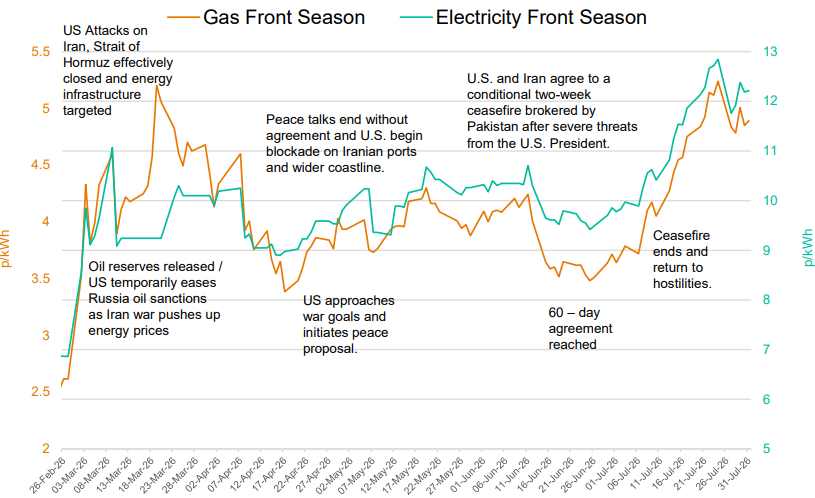
UK gas and power curve prices moved sharply higher across July as the return to hostilities between the US and Iran, escalating rhetoric from both sides, and renewed disruption across key Middle East shipping routes rebuilt geopolitical risk premium. Front season gas rose by 32% month-on-month, with the market reassessing the risk to Gulf LNG flows after attacks around the Strait of Hormuz, and disruption in the Red Sea. Higher oil prices, below-normal European storage and concern over a wider regional conflict kept winter contracts well supported.
- Early in the month, the ceasefire backdrop deteriorated as US-Iran rhetoric hardened and further military exchanges raised concern that the June de-escalation had failed.
- Renewed attacks on commercial vessels near the Strait of Hormuz, including Qatari LNG-linked shipping, pushed the curve higher as traders repriced the risk of disrupted Gulf LNG flows.
- Mid-month, President Trump said the ceasefire was effectively over, while Iran continued to challenge US claims that commercial transit through the Strait of Hormuz could remain secure.
- Later in the month, vessel traffic through the Strait of Hormuz slowed to multi-week lows, with some tankers turning back and shipping operators adopting a more cautious approach.
- Disruption in the Red Sea, a key shipping corridor linking the Indian Ocean to the Suez Canal and Europe, added to the regional risk premium by increasing concern over freight delays, insurance costs and the potential spread of conflict across multiple energy transit routes.
- Oil prices rose as renewed hostilities threatened Gulf exports, reinforcing bullish sentiment across gas and power through wider energy risk and oil-linked pricing channels.
- By the end of July, European gas storage was around 57% full, compared with a fiveyear average of around 69%, leaving winter contracts sensitive to any delay in LNG recovery or further disruption to summer injections.
- Renewed US interest in diplomacy could reduce geopolitical risk premium if talks progress.
- Normalisation of shipping through the Strait of Hormuz would ease concern over LNG availability.
- Stronger European storage injections would improve winter supply confidence.
- Iran’s denial that talks are planned underlines the risk that diplomacy fails again.
- Further attacks on vessels in the Strait of Hormuz or Red Sea would increase energy transit risk.
- European storage well below the five-year average leaves winter prices highly sensitive to further LNG disruption.
- US-Iran hostilities resumed in July, with fresh strikes, harder rhetoric and attacks on commercial vessels undermining the mid-June de-escalation agreement.
- The Strait of Hormuz remained the main flashpoint, with conflicting US and Iranian claims over whether commercial transit was open and safe.
- Vessel traffic through the Strait slowed sharply, while Red Sea disruption added to concern over wider regional shipping risk.
- Qatari LNG remained exposed, with cargo delays, diversions and cautious shipowner behaviour limiting confidence in a quick recovery.
- Gas, power and oil prices rose as the market rebuilt geopolitical risk premium, particularly across front-month and front-season contracts.
- The main concern was not only immediate supply loss, but whether prolonged shipping disruption will continue to limit LNG availability into Europe’s storage refill period.
- Below-average European storage amplified the price impact, keeping winter contracts sensitive to any further disruption.
- Recent US signals suggest some willingness to explore diplomacy, but Iran has denied talks are planned and messaging remains inconsistent.
- Prices could soften if talks resume and shipping normalises, but the market is likely to remain cautious given previous failed de-escalation attempts.
- Further vessel attacks, Red Sea disruption or renewed threats to Qatari LNG would keep risk premium supported.
In Other News
The new UK Prime Minister moved quickly to cut taxes on household electricity bills, signaling that affordability and wider cost-of-living support remain central to near-term energy policy, alongside the wider government focus on clean energy investment and household decarbonisation.
Seasonal Prices
Price Table
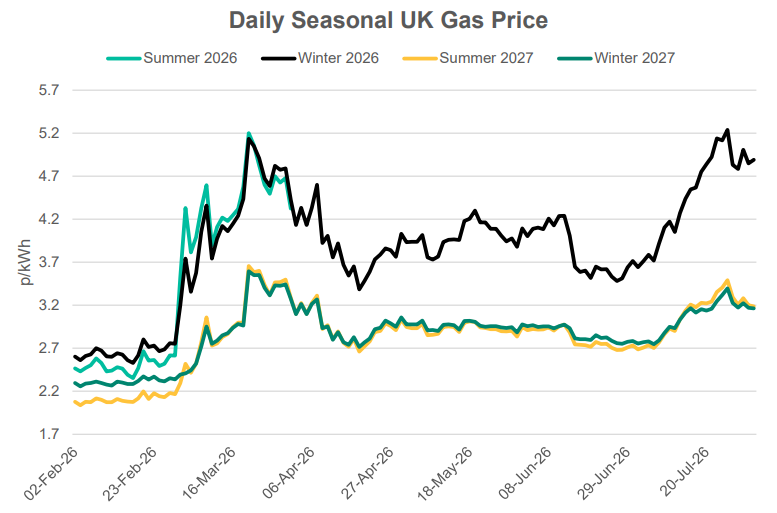
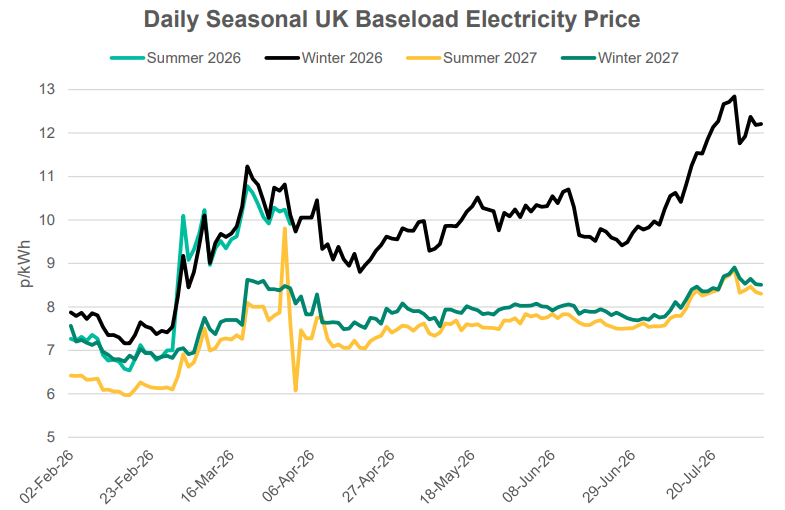
Prices rose strongly month-on-month across all gas and power products, with the sharpest increases seen in front-month and front-season contracts as geopolitical risk premium rebuilt quickly. Spot prices also moved higher, while annual products increased by a smaller but still material amount, showing that the impact extended beyond prompt volatility and into longer-dated hedging periods.
Month End Energy Only Prices
Spot Prices
| Fuel | July-26 (p/kWh) | June-26 (p/kWh) | Month-on-Month Difference |
|---|---|---|---|
| Gas (NBP) | 4.44 | 3.73 | 19% |
| Power (UK Baseload) | 11.14 | 10.15 | 10% |
Front Months
| Fuel | July-26 (p/kWh) | June-26 (p/kWh) | Month-on-Month Difference |
|---|---|---|---|
| Gas (NBP) | 4.85 | 3.59 | 35% |
| Power (UK Baseload) | 12.19 | 9.95 | 23% |
Front Season
| Fuel | July-26 (p/kWh) | June-26 (p/kWh) | Month-on-Month Difference |
|---|---|---|---|
| Gas (NBP) | 4.89 | 3.71 | 32% |
| Power (UK Baseload) | 12.21 | 9.85 | 24% |
Annual Price (Oct-26)
| Fuel | July-26 (p/kWh) | June-26 (p/kWh) | Month-on-Month Difference |
|---|---|---|---|
| Gas (NBP) | 4.38 | 3.42 | 28% |
| Power (UK Baseload) | 10.45 | 8.83 | 18% |
Outlook
The curve will remain highly sensitive to Middle East headlines, but the immediate risk of further US escalation has eased slightly after President Trump pulled back from additional attacks and signaled a willingness to explore diplomacy. Iran has denied that talks are due to take place, and messaging remains mixed, so the market is likely to stay cautious given previous failed de-escalation attempts. Clearer evidence of sustained talks, safer shipping and recovering LNG flows would be needed before much of July’s risk premium unwinds.
Bearish Signals
Bullish Signals
Middle East Conflict Update
Lastest Developments
Market Impacts
Future Risk
Price movement since the war began
Wider Historical Context
Want the best energy and water contracts for your business?
Get in touch today to start saving money and time spent on finding the best business energy deals.