

As business energy consultants, we are constantly on the lookout for the finest deals on the market for our clients, and we work tirelessly to achieve these. Our monthly market reports provide views directly from our specialists. Use our price analysis, market signals, and political changes to help you make the right choice when it comes to energy decisions.
Download PDFDisclaimer: The information contained in this document has been prepared in good faith by Ginger Energy and provides our views on current/future trends and outcomes, but, as with all forecasts dependent upon multiple, complex variables, there is no certainty whatsoever that our forecasts will turn out to be correct. The information may be based on licenced 3rd party data, publicly available sources, assumptions, and observable market conditions and may change without notice. No warranty, express or implied, is made as to the accuracy, correctness, fitness for purpose, completeness or adequacy of this information nor is it intended to serve as basis for any procurement decision and as such Ginger Energy shall not accept any responsibility or liability for any action taken, financial or otherwise, as a result of this information. Please note that this email is intended for the recipient only and may not be copied, reproduced, or distributed without the prior consent of Ginger Energy.
Market Context
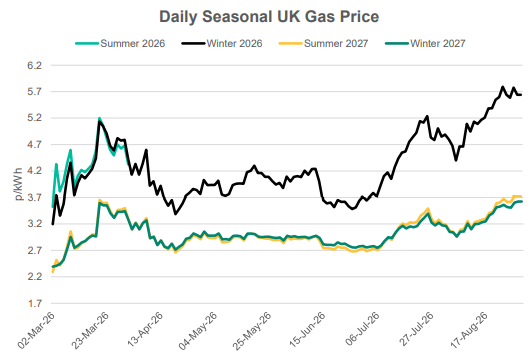
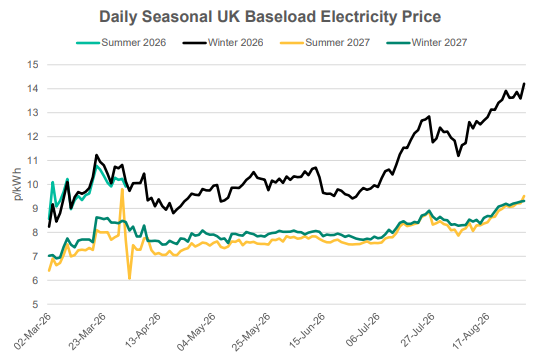
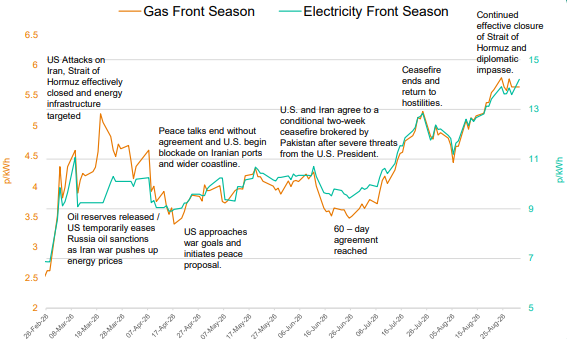
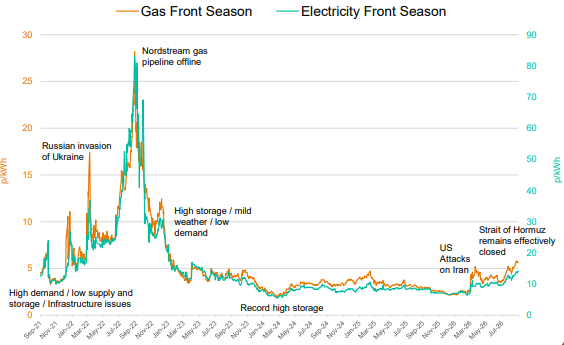
UK gas and power curve prices rose strongly across August, Winter 26 gas prices increased by around 15% month-on-month, despite losing some value early in August. Initial optimism that diplomacy could reopen the Strait of Hormuz, the key Gulf shipping route for oil and liquefied natural gas (LNG), briefly reduced risk premium. However, the absence of a confirmed agreement, continuing attacks on vessels and a tougher US economic stance towards Iran saw prices recover to three-year highs late in the month. Low European storage and uncertainty over Gulf LNG availability kept winter gas and power contracts well supported.
- Early August saw prices fall after the US paused planned strikes on Iran, and Iran and Oman reported progress on a potential shipping arrangement through the Strait of Hormuz. Markets remained cautious, however, as neither a full reopening nor reliable commercial transit was confirmed.
- Mid-month, the curve recovered as Iranian demands for US concessions and conflicting statements over negotiations reduced confidence in a diplomatic solution. Continued disruption to shipping kept concerns over the availability and cost of LNG for Europe firmly in focus.
- The expiry of the US-Iran memorandum of understanding, followed by tougher US sanctions and Iranian threats of retaliation, pushed front-season gas and power contracts back towards, and then above, previous post-conflict highs.
- Vessel traffic through the Strait of Hormuz remained far below normal, while disruption around Bab el-Mandeb, the southern entrance to the Red Sea, added to freight, insurance and delivery risks for oil and LNG moving between the Middle East, Asia and Europe.
- Prompt gas and power balances were often relatively comfortable, supported at times by stronger wind and solar generation, recovering Norwegian supply and steady UK demand. These factors limited some day-ahead moves but did little to remove the geopolitical premium from winter contracts.
- By late August, European gas storage was 63% full, compared with a five-year average of 79%. The shortfall leaves Europe with a materially smaller buffer ahead of winter and increases the curve’s sensitivity to LNG disruption, cold weather or further infrastructure outages.
- A credible and sustained reopening of the Strait of Hormuz.
- Stronger Norwegian supply, comfortable UK balances and further renewable generation.
- Continued European LNG arrivals and storage injections.
- European storage remains materially below the seasonal average as the winter heating season approaches.
- Further attacks or restrictions affecting the Strait of Hormuz or Bab el-Mandeb
- A cold winter, weak renewable output or reduced nuclear and hydro availability.
- August began with optimism that talks involving Iran and Oman could establish a temporary route for commercial traffic through the Strait of Hormuz. This briefly reduced energy-market risk premium, but the arrangement was never confirmed as a reliable reopening.
- The US and Iran continued to issue conflicting statements on negotiations. Iran maintained that reopening the waterway required wider US concessions, while Washington shifted towards tougher economic pressure and sanctions.
- The expiry of the previous US-Iran memorandum of understanding removed an important, if fragile, basis for de-escalation. The subsequent hardening of positions increased concern that disruption could continue into the winter period.
- Commercial traffic through the Strait of Hormuz remained exceptionally low, with reported vessel attacks and security incidents reinforcing the reluctance of shipowners to resume normal operations.
- Risk also remained elevated around Bab el-Mandeb, the Red Sea shipping chokepoint linking the Indian Ocean with the Suez Canal, where disruption continued to threaten Saudi Arabia’s alternative oil-export route and lengthen shipping journeys.
- Gas, power and oil markets were highly volatile but moved higher overall as the market reassessed the likelihood that reduced Gulf LNG availability could persist through Europe’s storage-refill period.
- The effect on UK and European prices was amplified by low storage levels. With inventories materially below normal, the market has less flexibility to absorb a prolonged loss of LNG supply or stronger winter demand.
- Oil prices remained an important transmission mechanism into gas and power markets. Higher crude prices reflected concern over restricted Middle Eastern exports and reinforced broader energy-market risk sentiment.
- Physical UK fundamentals were often more comfortable than the forward-price response suggested, but stable Norwegian flows and renewable output could not fully offset the risk of tighter European LNG competition.
- A verified agreement restoring safe, regular passage through the Strait of Hormuz would be the clearest route to lower gas and power prices, improving confidence in LNG supply and European storage replenishment.
- However, partial transit arrangements, conflicting political statements and continuing vessel-security incidents mean that any easing is likely to remain fragile until normal commercial traffic resumes.
- The key risk for winter contracts is that restricted Gulf LNG flows become a lasting market condition rather than a temporary disruption. This would leave Europe increasingly dependent on competing for alternative LNG cargoes while entering winter with below-average storage.
In Other News
Periods of hot and low-wind weather reduced French nuclear availability and increased gas-fired power demand in parts of Europe, highlighting the continued interaction between weather, power-system reliability and gas demand.
Seasonal Prices
Price Table
Periods of hot and low-wind weather reduced French nuclear availability and increased gas-fired power demand in parts of Europe, highlighting the continued interaction between weather, power-system reliability and gas demand.
Month End Energy Only Prices
Spot Prices
| Fuel | Aug-26 (p/kWh) | July-26 (p/kWh) | Month-on-Month Difference |
|---|---|---|---|
| Gas (NBP) | 5.18 | 4.44 | 17% |
| Power (UK Baseload) | 12.95 | 11.14 | 16% |
Front Months
| Fuel | Aug-26 (p/kWh) | July-26 (p/kWh) | Month-on-Month Difference |
|---|---|---|---|
| Gas (NBP) | 5.53 | 4.85 | 14% |
| Power (UK Baseload) | 13.53 | 12.19 | 11% |
Front Season
| Fuel | Aug-26 (p/kWh) | July-26 (p/kWh) | Month-on-Month Difference |
|---|---|---|---|
| Gas (NBP) | 5.64 | 4.89 | 15% |
| Power (UK Baseload) | 14.21 | 12.21 | 16% |
Annual Price (Oct-26)
| Fuel | Aug-26 (p/kWh) | July-26 (p/kWh) | Month-on-Month Difference |
|---|---|---|---|
| Gas (NBP) | 5.07 | 4.38 | 16% |
| Power (UK Baseload) | 12.10 | 10.45 | 16% |
Outlook
The forward curve is likely to remain highly sensitive to the outlook for commercial shipping through the Strait of Hormuz and the resulting availability of Middle Eastern LNG. A credible agreement that restores regular, safe transit could reduce oil and LNG risk premium and allow prices to ease, particularly if Norwegian supply remains stable and European storage injections continue. However, storage is well below seasonal norms, and the period available to rebuild inventories before winter is now limited. Any further shipping incidents, delays to LNG recovery, colder weather or weakness in wind, hydro or nuclear output would increase Europe’s call on gas and could drive renewed strength in winter and summer 2027 contracts.
Bearish Signals
Bullish Signals
Middle East Conflict Update
Lastest Developments
Market Impacts
Future Risk
Price movement since the war began
Wider Historical Context
Want the best energy and water contracts for your business?
Get in touch today to start saving money and time spent on finding the best business energy deals.