


HEAT NETWORK BILLING AGENTS MANCHESTER
Ginger Energy provide a complete outsource billing and customer services interface solution to building owners and managers of buildings in Manchester which operate a heat network.

METERING AND BILLING SERVICES
- MAIN METER PROCUREMENT
- READ DATA RETRIVAL
- BILLING SERVICES
- ACCOUNT MANAGEMENT
- TENANT PAYMENTS
- FINANCIAL MANAGEMENT
- CUSTOMER SERVICES INTERFACE
- DEBT COLLECTION
Why heat networks, why now?
The UK has made a clear commitment to be net zero by 2050. Heat is currently responsible for 37% of UK carbon emissions and although since 1990 it is down 25%, there is still a long way to go to decarbonise the industry. Half of these heat emissions are from domestic buildings, which are mostly heated by traditional gas boilers. Large scale changes in heat generation and consumption are required nationally, as the UK government moves away from natural gas dependency and single residency heat production.
Reaching net zero will not only mean embracing low-carbon technologies such as heat pumps, fuel cells, energy from waste, and biomass, but also using our existing gas network in a new way, through heat networks.
The UK government has actively encouraged change by injecting £320 million into heat schemes between 2017 and 2021. Developers are to be banned from installing domestic gas boilers from 2025, so alternatives such as heat pumps, hybrid systems, and hydrogen-ready boilers are being installed instead. Therefore, project developers & project managers in Manchester are partnering with Ginger Energy to manage their heat networks in Manchester as we pride ourselves in being specialist communal energy partners.
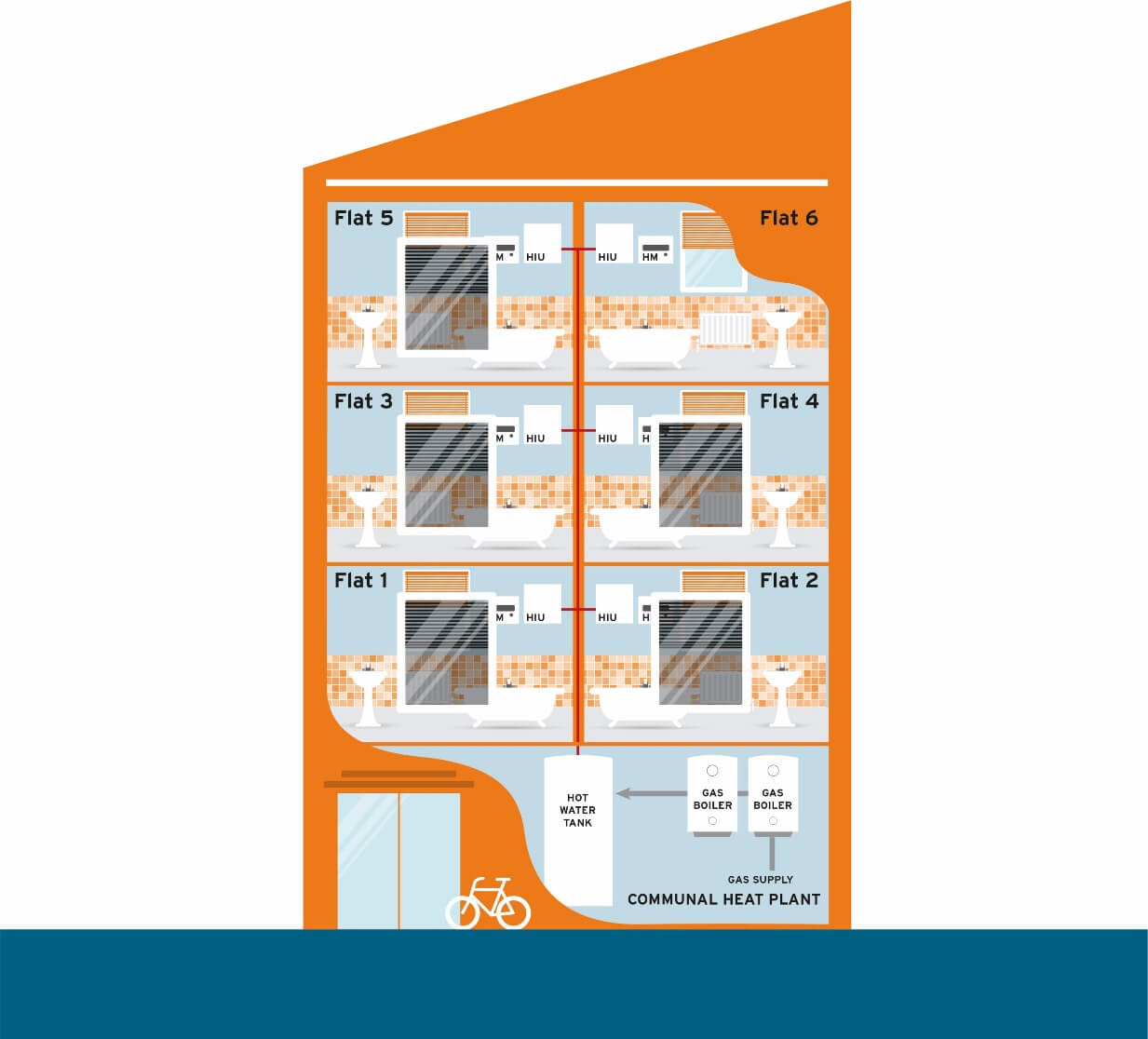
In the majority of cases, a residential block will have a communal heat supply located in the heart of the building in the plant room, which, through a series of insulated pipes, is delivered to its residents.
Key benefits of heat networks
Ability to use thermal storage and local renewable resources at a larger scale
Power co-generation potential leading to high efficiency
Heat source flexibility
Better use of renewable fuels when they become available than household boilers
Long-term capability of using a national hydrogen or biogas network
HOW CAN GINGER ENERGY HELP IN MANCHESTER?
Focus your attention on core services, safe in the knowledge that residents are being compliantly invoiced
and given the very best in customer service support with Ginger Energy.
Comprehensive Services
Ginger Energy provide a complete outsource billing and customer services interface for owners and managers of buildings, who operate a heat network. We work with many residential block managers and owners who outsource the heat network billing, customer service and debt collection responsibilities.
Flexible Solutions
We can adopt existing infrastructure and take over responsibility or can start afresh on new developments. Having worked with many data platforms we can provide impartial advice on the most appropriate solutions to meet the needs of each building and its occupiers.
Collaborative Approach
Our on-boarding process includes a sponsored resident evening, giving a presentation on heat networks and providing opportunity to meet the Ginger Energy team and ask any questions. We find this minimises the disputes and creates a collaborative feel for all parties.
Network operations & maintenance
- Optimisation studies & grant applications
- Planned preventative maintenance
- Reactive maintenance
- HIU servicing
- Boiler, CHP & HVAC maintenance
- Meter replacement
Essentially, we can support your business and the residents who occupy a heat network building in Manchester. Residents will be compliantly invoiced and receive support services from Ginger Energy’s billing team, experts in communal energy.
WHY GINGER ENERGY – COMMUNAL ENERGY PARTNERS IN MANCHESTER?
Experienced Team
With over two decades of experience, we have organically grown into a team of trusted heat network billing agents, managing nearly 10,000 supply points for a range of clients. We operate across(but aren’t limited to) London, Birmingham and Manchester
Transparency & Openness
We take pride in our independence. As we are not associated with any single supplier or metering provider, you can expect transparency and openness at any stage of services.
Cost-effective Services
By providing focused heat network solutions, we are able to deliver excellent results. Benefit from our flexible and highly cost-effective solutions with unmatched value for money.
Tailored Solutions
At Ginger Energy, we treat every client differently based on their unique needs. This approach allows us to readily respond to the market and adapt to the changing energy demand.
You might be interested in

TENANT BILLING MANCHESTER
Save valuable time and resources with our comprehensive tenant billing for electricity, gas, water and heat networks.
Learn more>>
PORTFOLIO MANAGEMENT MANCHESTER
Identify the best energy opportunities with our full account management service that support landlords and block managers.
Learn more>>
UTILITY COMPLIANCE MANCHESTER
Ensure your energy processes meet all the regulations and explore our comprehensive utility compliance services.
Learn more>>Heat Network FAQs
It is predicted that 5 million homes (24% of residential heat demand), will have heat supplied by heat networks by 2050.
CHP – Combined Heat & Power. These are large scale electricity generators usually running on natural gas, which capture the heat created from the process that would normally go to waste. The heat is then used to produce hot water and, in a heat network, distributed to the local homes or businesses while the electricity goes into the national grid. The generator will usually be paid a fee for generation. This is often called co-generation and is much more efficient than separate electricity and heat generation.
Or
CHP – Communal Heat Plant. These are the plant rooms often buried in the basement of a building which contain the heat generation equipment. The heat generation equipment could be CHP, commercial gas boilers, biomass, or heat pumps.
The first part of the regulations, launched in 2014, requires heat network operators to complete a notification of data from all qualifying heat networks to notify the Secretary of State through The Office for Product Safety Standards (OPSS) which is part of The Office of Business Energy and Industrial strategy (BEIS). The process must be repeated every four years from the date of the original submission. Future notifications require additional information regarding building classes.
The second part came into effect 27 November 2020 and requires heat network operators to determine if they must install heat meters or heat cost allocators into their buildings.
To define which networks will be required to install these, BEIS has introduced three building classes:
- Viable – Those who must install heat meters
- Open – Those who must complete a viability exercise to determine if they are required to install meters or heat cost allocators
- Exempt – No action required
If buildings fall into the open class, heat network operators have until 27 November 2021 to complete a full input cost-effectiveness tool to assess whether it is cost effective to install heat metering devices. If heat meter or heat cost allocator installation is required, installation of all required devices must be completed by 1 September 2022.
Most modern buildings have a Heat Interface Unit (HIU) inside each apartment and the HIU will usually include a heat meter that works just like a gas or electricity meter so that the more heat the resident extracts from the heat network, the higher the recorded number on the heat meter will be but there are some developments without heat meters or cost allocators and it is these buildings that the second, more recent regulatory requirements is aimed towards.
In addition to the above, and as you may expect, there is an ongoing requirement to maintain plant, metering or cost allocators and fix errors. Ensuring the plan is optimised and as such is efficient is also an important element, because unnecessary heat loss will result in high consumption charges which are passed onto residents.
Additionally, and importantly, there is the responsibility to produce compliant onward charging to residents and recover those charges.
Where heat meters or cost allocators are installed, billing must be based on actual measured consumption, in line with the Heat Network (Metering and Billing) Regulations 2014 (as amended), unless a valid exemption applies. Managing a heat network involves:
• Collecting meter readings
• Calculating usage and charges
• Issuing bills
• Responding to resident queries
• Managing payments
What’s changing? From 27 January 2026, Ofgem formally began regulating heat networks under the Energy Act 2023. This introduces stronger consumer protections, including requirements for:
• Fair and transparent pricing
• Clear billing information
• Formal complaints procedures
• Protections for vulnerable consumers
Ofgem is taking a phased approach to regulation. The initial set of rules is now in place. By early 2027, the full rulebook – including pricing standards and Guaranteed Standards of Performance – will be published.
As a result, billing must not only be accurate, but also fair, transparent, and easy for residents to understand. Many managing agents choose to work with specialist billing providers to ensure compliance and reduce administrative burden.
Where the lease strictly prescribes how charges must be calculated or recovered, and this cannot legally be varied, that may limit the supplier’s ability to fully align with the billing-related requirements. In those cases, the supplier should be able to demonstrate why the arrangements cannot be changed, what constraints apply, and what steps they have taken to mitigate any adverse impact on consumers.
In short, lease terms may restrict what can be changed, but they do not remove the expectation to comply with the authorisation conditions wherever possible, or to justify clearly where full compliance is not achievable.
Looking ahead: With Ofgem’s regulation now active from January 2026, consumer protection standards are being strengthened in a phased manner. Lease terms will not override these protections. Existing operators have until January 2027 to register with Ofgem, and the full rules – including pricing – will be in place by early 2027.
We recommend:
• Notifying the freeholder
• Reviewing lease terms
• Seeking specialist legal advice to ensure full compliance
What’s changing? Now that Ofgem’s regulation is in force from January 2026:
• There will be greater scrutiny of exemption claims
• Compliance will be more actively enforced
• Operators may face penalties for failing to meet requirements
• Consumers will have a clear route to hold operators and suppliers accountable if their heat network fails to meet expectations
We recommend reviewing your current position to ensure your network remains compliant under both existing and forthcoming regulations.
This situation, if not managed correctly, can result in dissatisfied leaseholders and high debts for the building owner or manager. Particularly for blocks which have a high level of investors rather than owner-occupiers, it is vital to have a solution in place that can help to protect them as well as allow you as the block owner or managing agent, to control debt and reduce complaints.
Ginger Energy has developed a multi-level leaseholder and sub tenant billing platform and service for our communal heat schemes clients, ideal for schemes with a high volume of investor properties. Investors that might otherwise be put off purchasing a property in a heat network block.
For more information regarding our services please contact us as we would be delighted to talk.