

As business energy consultants, we are constantly on the lookout for the finest deals on the market for our clients, and we work tirelessly to achieve these. Our monthly market reports provide views directly from our specialists. Use our price analysis, market signals, and political changes to help you make the right choice when it comes to energy decisions.
Download PDFDisclaimer: The information contained in this document has been prepared in good faith by Ginger Energy and provides our views on current/future trends and outcomes, but, as with all forecasts dependent upon multiple, complex variables, there is no certainty whatsoever that our forecasts will turn out to be correct. The information may be based on licenced 3rd party data, publicly available sources, assumptions, and observable market conditions and may change without notice. No warranty, express or implied, is made as to the accuracy, correctness, fitness for purpose, completeness or adequacy of this information nor is it intended to serve as basis for any procurement decision and as such Ginger Energy shall not accept any responsibility or liability for any action taken, financial or otherwise, as a result of this information. Please note that this email is intended for the recipient only and may not be copied, reproduced, or distributed without the prior consent of Ginger Energy.
Market Context
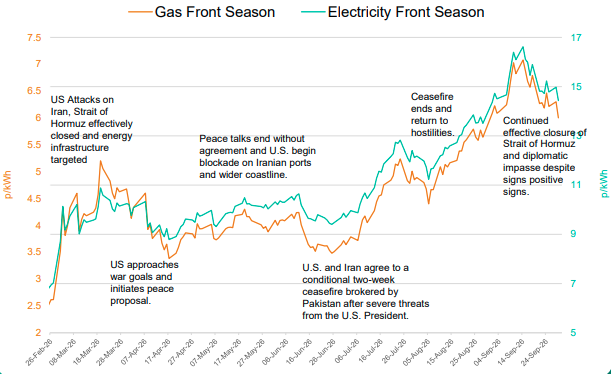
UK gas and power curves rose during September, although prices retreated from their mid- month highs. Renewed US–Iran hostilities, attacks on shipping and low European gas storage increased concern over winter supply. Front-season gas climbed to around 26% above August’s closing level by mid-month, before diplomatic optimism and improving Norwegian supply reversed part of the rally. It ended September approximately 10% higher month-on-month, while front-season power gained 4%. The late-month correction reduced geopolitical risk premium, but did not signal a return to normal LNG availability.
- Mid-month attacks spread beyond the Strait of Hormuz, the Gulf shipping route for oil and LNG. Damage to Saudi Arabia’s East-West Pipeline, its alternative crude-export route to the Red Sea, reinforced concerns over prolonged energy-supply disruption.
- Later in September, diplomatic engagement around the UN General Assembly encouraged selling across forward contracts. However, mixed messages from Washington and Tehran, continuing attacks and the absence of a confirmed agreement kept prices volatile.
- Recovering Gulf oil exports and the restart of Saudi Arabia’s alternative export route eased immediate supply concerns towards month-end. LNG shipments remained much more restricted, limiting the improvement in Europe’s winter gas outlook.
- Heavy Norwegian maintenance constrained supply during the month. Its gradual completion, alongside mild late-September weather, improved the European gas balance and supported stronger storage injections.
- Qatar extended delivery suspensions affecting European and Asian customers. Although some LNG tanker movements resumed, buyers continued to compete for replacement cargoes ahead of winter.
- By late September, EU gas storage was around 70% full, roughly 12 percentage points below the same point last year. The month-end picture remained uneven: France reached 83%, while Germany’s comparatively low inventories remained a concern.
- A durable diplomatic agreement and sustained recovery in Gulf LNG exports would reduce supply risk and competition for replacement cargoes.
- Mild winter weather and stronger renewable generation would lower heating and gas- fired power demand.
- Reliable Norwegian supply and increasing non-Gulf LNG availability would improve Europe’s balance and preserve storage.
- Below-normal European storage leaves winter contracts exposed to cold spells and faster withdrawals.
- Failed negotiations, renewed shipping attacks or further infrastructure damage could prolong restrictions on Gulf LNG supply.
- Stronger Asian LNG demand or unexpected supply outages would increase competition for cargoes and support UK gas and power prices.
- Renewed US–Iran attacks and vessel strikes restricted traffic through the Strait of Hormuz, the Gulf shipping route for oil and LNG. Planned regional talks were postponed.
- Houthi advances increased risks around Bab el-Mandeb, the southern entrance to the Red Sea. Drone attacks also shut Saudi Arabia’s East-West Pipeline, its alternative crude-export route bypassing Hormuz, before operations resumed later in September.
- Diplomacy around the UN General Assembly encouraged optimism, but the US rejected Iran’s proposed reopening framework. Further indirect talks had not produced a confirmed agreement by month-end.
- Gulf oil exports recovered strongly towards month-end, while LNG shipments remained
well below normal. Qatar Energy extended delivery suspensions affecting European and
Asian customers despite some tanker movements resuming.
Market Impacts
- Restricted Gulf LNG shipments and extended Qatari delivery suspensions increased competition for replacement cargoes, keeping European and Asian gas procurement costs elevated.
- Attacks on shipping and Saudi export infrastructure increased transport costs and oil- supply concerns. Recovering oil exports later in September eased some pressure, but offered limited relief to gas markets while LNG deliveries remained constrained.
- Diplomatic optimism reduced geopolitical risk premium late in the month. However, continuing vessel attacks and the absence of a confirmed agreement left prices sensitive to setbacks in negotiations.
- A durable agreement restoring safe, regular LNG deliveries would offer the clearest route to lower gas and power prices. Political assurances alone are unlikely to sustain a correction.
- Partial reopening would not immediately restore all lost supply, with existing damage to Qatari LNG production facilities remaining a longer-term constraint.
- Prolonged disruption combined with cold weather, weak renewable generation or further outages could accelerate storage withdrawals and intensify LNG competition, supporting winter gas and electricity prices.
Future Risk
Price movement since the war began

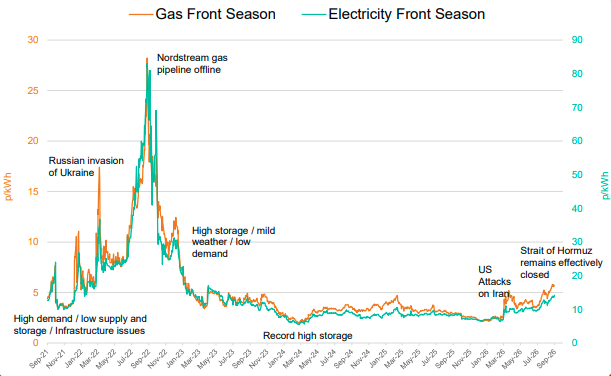
Wider Historical Context
Want the best energy and water contracts for your business?
Get in touch today to start saving money and time spent on finding the best business energy deals.
In Other News
Prime Minister, Andy Burnham, announced plans for Great British Grid (GB Grid), a publicly owned body within Great British Energy, to accelerate grid connections and reduce energy costs. The proposal aims to bring Britain’s energy costs into line with other European countries within ten years.
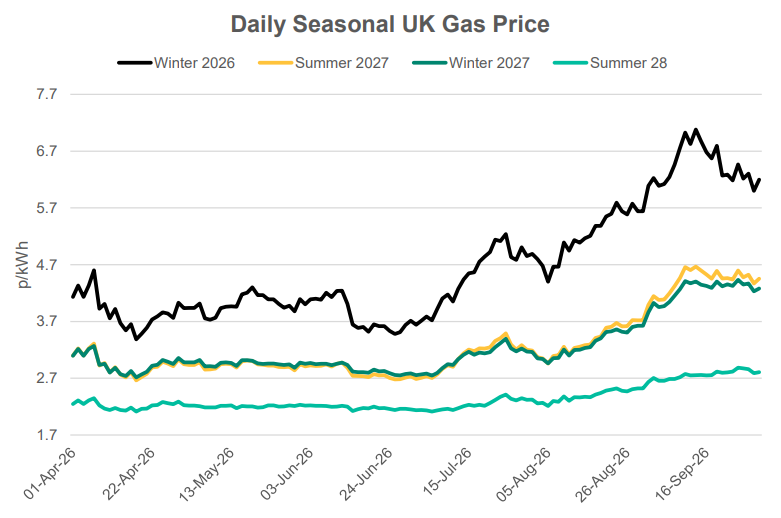
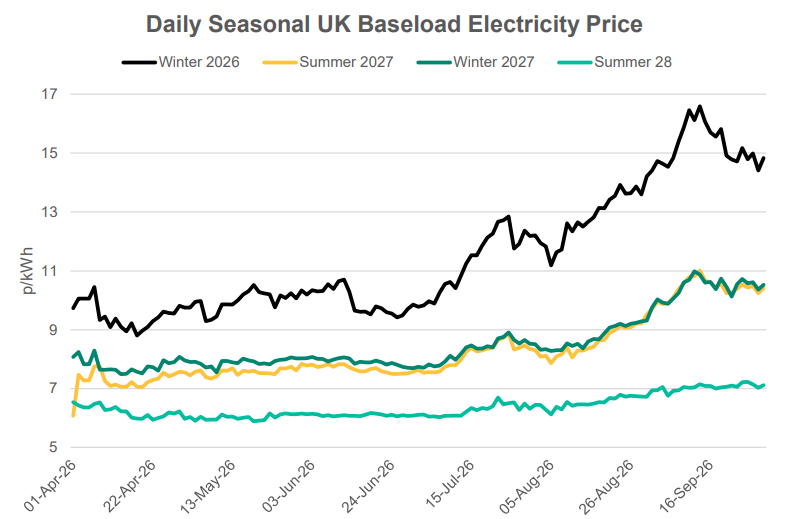
Seasonal Prices
Price Table
All listed gas and power products ended September above August’s closing levels, with gas recording the larger increases. Spot gas showed the strongest rise, while front-month and front-season contracts also strengthened. The October-start annual products increased more than the corresponding monthly and seasonal contracts for both fuels. Winter delivery remained more expensive than the annual products, highlighting the premium attached to the coming heating season despite the late-month correction.
Energy Only Prices
Spot Prices
| Fuel | Sep-26 (p/kWh) | Aug-26 (p/kWh) | Month-on-Month Difference |
|---|---|---|---|
| Gas (NBP) | 6.38 | 5.18 | 23% |
| Power (UK Baseload) | 13.50 | 12.95 | 4% |
Front Months
| Fuel | Sep-26 (p/kWh) | Aug-26 (p/kWh) | Month-on-Month Difference |
|---|---|---|---|
| Gas (NBP) | 6.10 | 5.53 | 10% |
| Power (UK Baseload) | 14.11 | 13.53 | 4% |
Front Season
| Fuel | Sep-26 (p/kWh) | Aug-26 (p/kWh) | Month-on-Month Difference |
|---|---|---|---|
| Gas (NBP) | 6.20 | 5.64 | 10% |
| Power (UK Baseload) | 14.83 | 14.21 | 4% |
Annual Price (Oct-26)
| Fuel | Sep-26 (p/kWh) | Aug-26 (p/kWh) | Month-on-Month Difference |
|---|---|---|---|
| Gas (NBP) | 5.68 | 5.07 | 12% |
| Power (UK Baseload) | 12.84 | 12.10 | 6% |
Outlook
Winter pricing will depend on whether diplomatic progress translates into safe, sustained Gulf LNG shipments. Improving Norwegian supply and mild weather could allow further easing, but Europe’s relatively low storage leaves limited protection against prolonged disruption or cold spells. Even without fresh escalation, competition for replacement LNG may keep gas and power forwards supported. A credible agreement could remove more risk premium, although restoring dependable deliveries would take time. Further ahead, expanding global LNG capacity offers scope for lower prices, but the timing of supply recovery and winter storage depletion will shape the summer refill requirement.